

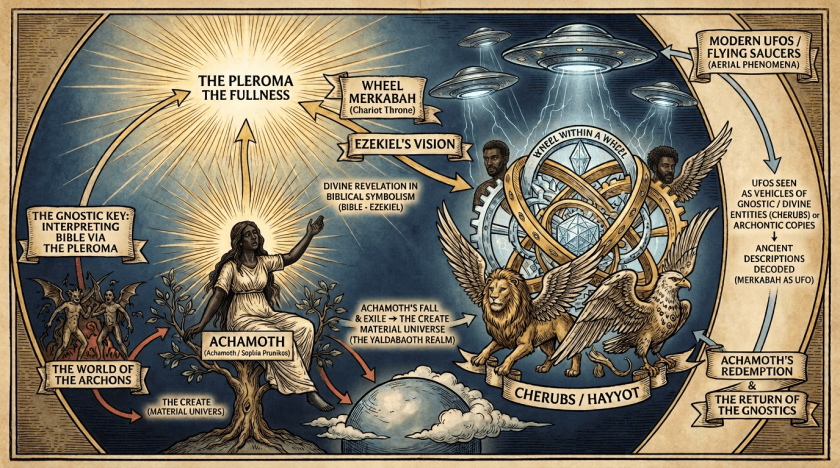
Achamoth, UFOs, Cherubs, and Chariots: A Gnostic and Biblical Explanation
Achamoth in Gnosticism
Achamoth—also called Sophia Achamoth or Lower Sophia—is a figure found especially in later Gnostic systems, including Valentinian traditions. She is associated with Sophia, the divine Wisdom.
In many Gnostic accounts:
- Sophia desires to understand or approach the ultimate divine reality.
- Her movement produces disorder or deficiency.
- She is separated from the higher spiritual realm, known as the Pleroma.
- The lower aspect of Sophia, often called Achamoth, becomes connected with the formation of the material cosmos.
- From this process arise the Demiurge, the creator-ruler of the material world, and various spiritual beings.
Gnostic writings differ considerably, so Achamoth does not have one single universally accepted role. Generally, she represents fallen or incomplete wisdom seeking restoration.
Cherubs in the Bible
In the Bible, cherubim are powerful heavenly beings associated with God’s presence, holiness, and throne. They are not portrayed as the small, winged childlike figures common in later European art.
Important passages include:
- Genesis 3:24 — Cherubim guard the way to the tree of life.
- Exodus 25:18–22 — Cherubim are placed above the Ark of the Covenant.
- 1 Kings 6 — Large cherubim appear in Solomon’s Temple.
- Ezekiel 1 and 10 — Cherubim are connected with the mysterious living creatures and the divine chariot-throne.
Ezekiel’s cherubim have multiple faces, wings, human-like hands, and complex movement. They symbolize heavenly guardians and bearers of God’s glory.
Ezekiel’s Chariot Vision
In Ezekiel 1, the prophet describes a vision beside the River Chebar. He sees:
- A storm wind and a great cloud
- Fire and flashing lightning
- Four living creatures
- Four faces and four wings
- Legs like those of a calf
- Wheels within wheels
- Wheels covered with eyes
- A shining platform
- A throne-like appearance above it
- A figure resembling a human form surrounded by radiance
Ezekiel later identifies the living creatures as cherubim in chapter 10. The vision is commonly called the Merkabah, Hebrew for “chariot.”
The chariot is not merely a vehicle in an ordinary physical sense. It represents the mobile throne of God, emphasizing that God’s presence is not confined to the Jerusalem Temple. The wheels and living beings communicate divine movement, power, awareness, and cosmic authority.
Are Ezekiel’s Chariots UFOs?
Some modern writers interpret Ezekiel’s vision as an encounter with an extraterrestrial spacecraft. They point to details such as:
- Fire and brilliant light
- Rotating or intersecting wheels
- Metallic or reflective appearances
- Strange beings
- A platform or throne above the wheels
- Movement in multiple directions
However, this is a modern speculative interpretation, not the traditional Jewish or Christian understanding of the text.
Within its biblical context, Ezekiel is describing a prophetic throne vision using symbolic and highly poetic imagery. The “wheels” are linked to God’s heavenly presence, and the beings are later called cherubim. The text does not identify them as machines, spacecraft, or beings from another planet.
The comparison to UFOs can be useful as a modern analogy for the vision’s strangeness, but it should not be confused with the original religious meaning.
Possible Connections with Gnosticism
There are thematic similarities between Ezekiel’s vision and some Gnostic ideas:
- Both involve layered spiritual realities.
- Both describe heavenly beings and cosmic rulers.
- Both use images of light, fire, movement, and transcendence.
- Both portray the visible world as connected to invisible powers.
Nevertheless, Ezekiel’s theology is fundamentally different from classical Gnosticism. In Ezekiel:
- The one God is the sovereign creator.
- The material world is not inherently evil.
- The cherubim serve God.
- The divine presence moves freely beyond the Temple.
In many Gnostic systems:
- The highest God is distinguished from the creator of the material world.
- The material cosmos may be viewed as defective or imprisoning.
- Salvation involves awakening to spiritual knowledge, or gnosis.
Thus, Ezekiel’s cherubim and chariot should not automatically be identified with Gnostic aeons, archons, or UFO occupants.
Summary
- Achamoth is a Gnostic figure associated with lower or fallen Sophia and the formation of the material realm.
- Cherubim are biblical heavenly beings connected with God’s throne and presence.
- Ezekiel’s chariot is a symbolic vision of God’s mobile throne, later associated with the cherubim.
- UFO interpretations are modern readings of the imagery, not the original biblical interpretation.
- Although Gnosticism and Ezekiel both use cosmic and visionary symbolism, they express different theological systems.

