

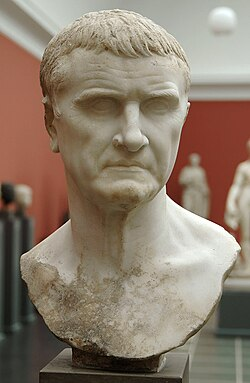
Overview
Marcus Licinius Crassus was a prominent Roman general and politician known for his immense wealth and significant role in the late Roman Republic. He is often remembered as a member of the First Triumvirate alongside Julius Caesar and Pompey the Great.
Early Life and Career
Crassus was born into a wealthy family and became one of the richest men in Rome through various ventures, including real estate and silver mining. His early political career was marked by his participation in the political struggles of the Republic.
Military Achievements
Crassus sought to enhance his military reputation, which was primarily overshadowed by his wealth. His notable military achievement includes the suppression of the Spartacus-led slave revolt (73–71 BC). This victory, however, was marred by a lack of experienced command, leading to criticism and diminishing his standing among his peers.
Political Influence
As a senator, Crassus wielded considerable influence in Roman politics. His alliance with Caesar and Pompey in the Triumvirate was pivotal in shaping the political landscape of the Republic. However, tensions within the alliance ultimately contributed to the conflicts that would lead to the downfall of the Republic.
Spartacus Revolt Slavery
The Spartacus Revolt, also known as the Third Servile War, was a significant slave uprising that took place from 73 to 71 BC. Led by Spartacus, a Thracian gladiator, the rebellion highlighted the tensions and injustices of slavery in ancient Rome.
Causes of the Revolt
The revolt primarily stemmed from the brutal conditions that slaves endured. Many were subjected to harsh treatment by their owners, prompting a desire for freedom and a better life. Spartacus, alongside about 70 other gladiators, escaped from a gladiatorial school in Capua, igniting the rebellion.
Major Events
Spartacus and his followers initially achieved several victories against Roman forces, amassing a diverse army of slaves and discontented individuals. They defeated multiple Roman legions, showcasing their resolve and military prowess. The revolt drew attention and led to significant alarm among Roman authorities.
Outcome
Despite early successes, the revolt was ultimately crushed in 71 BC by the Roman general Marcus Licinius Crassus. The aftermath resulted in the crucifixion of around 6,000 captured slaves along the Appian Way, serving as a grim reminder of the consequences of opposition to Roman authority.
Legacy
The Spartacus Revolt remains a powerful symbol of resistance against oppression and is often referenced in discussions surrounding themes of freedom and human rights. Spartacus himself has become an enduring figure in popular culture, symbolizing the fight against tyranny.
Syria Military Conquest
The military campaigns in Syria during the later Republic era represent crucial developments in Rome’s expansionist policy. Marcus Licinius Crassus played a significant role in these endeavors, aimed at solidifying Roman control over the region.
Background
After the success of the Spartacus Revolt, Crassus sought to further enhance his military reputation and political influence. The region of Syria was strategically important due to its proximity to the eastern frontiers of Rome and its wealth.
Campaign Initiation
In 53 BC, Crassus embarked on a campaign against the Parthian Empire, which had gained prominence and posed a threat to Roman interests. His decision to invade was motivated by the desire for glory and the potential for immense wealth from the eastern territories.
Key Battles
- Battle of Carrhae (53 BC): This pivotal battle saw Crassus’s legions face off against a much larger Parthian force. The lack of effective Roman cavalry and poor command decisions resulted in a disastrous defeat for Crassus. His forces were routed, leading to heavy casualties.
- Aftermath of Carrhae: Following the defeat, Crassus faced the retreat and disintegration of his army. The Parthians took advantage of this victory to assert their dominance over the region, deepening the humiliation of Rome.
Consequences
Crassus was eventually killed in 53 BC, and his failure significantly impacted Rome’s military standing in the east. The expedition revealed weaknesses in Roman military tactics and highlighted the need for more competent leadership in foreign campaigns.
Legacy of the Conquest
The Syria military campaign and its outcomes shaped Rome’s future engagements in the east. It signaled the importance of preparation and understanding of local dynamics in military conquests. Crassus’s ambitions ultimately served as a cautionary tale about the pitfalls of overreaching without adequate resources and strategy.
 Digital Information Publishing