

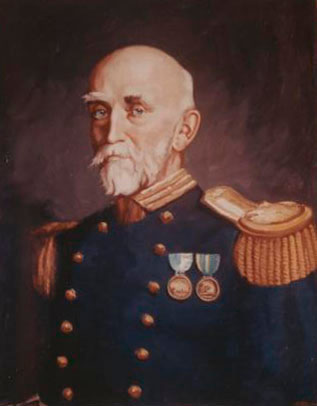
Alfred Thayer Mahan (1840–1914) was a prominent American naval officer and historian whose ideas on naval strategy profoundly influenced naval policy in the late 19th and early 20th centuries. Although he did not write specifically about the Middle East in the 1850s, his theories would have implications for maritime strategy that could be applied to the region.
Mahan is best known for his work The Influence of Sea Power upon History, 1660–1783, published in 1890. In it, he argued that national power was directly linked to naval supremacy and that control of the seas was essential for global dominance. His concepts emphasized the importance of a strong navy, strategic maritime chokepoints, and the development of overseas bases to support naval operations.
During the late 19th century, the Middle East was gaining attention due to its strategic location between Europe, Asia, and Africa, particularly concerning trade routes and military strategy. The Suez Canal, completed in 1869, exemplified this significance, as it became a vital link for naval powers seeking quicker access to territories in Asia and beyond.
Mahan’s theories likely inspired countries, including Great Britain and later other naval powers, to consider the Middle East’s geopolitical importance and the necessity of having a strong naval presence in the region. This laid early groundwork for later conflicts and international relations involving Middle Eastern territories, particularly during periods of imperial expansion and the eventual impact of World War I and beyond.
In summary, while Mahan did not specifically focus on the Middle East in the 1850s, his maritime theories and their consequences would have a lasting influence on how naval powers approached the region in the context of global sea power dynamics.
The Term Middle East Coined
The Term Middle East Coined
The term “Middle East” was popularized in the early 20th century, particularly in the context of geopolitical discussions surrounding the strategic significance of the region. It is believed that the phrase was first used by American naval officer Alfred Thayer Mahan in the late 19th century, although his focus was primarily on maritime strategy rather than specific regional terminology.
The term came into common usage as Western powers became increasingly interested in the region’s resources, trade routes, and strategic positioning, especially in relation to issues surrounding the Suez Canal and other critical maritime chokepoints. The Middle East encompasses a diverse array of cultures, languages, and histories, and its importance grew as global powers sought to expand their influence during the age of imperialism.
The evolution of the term reflects not only the geographical features of the region but also the political and economic interests that defined international relations in the 20th century. The Middle East has since become a central focus of global geopolitics, influenced by historical events, resource management, and conflicts that have arisen over the decades.
 Digital Information Publishing