

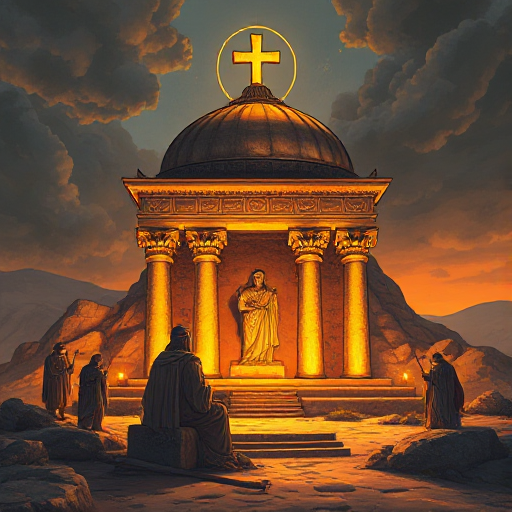
Yahwism, often referred to as the belief system surrounding the worship of Yahweh, is rooted in ancient Hebrew religion, which eventually evolved into what is now known as Judaism. This faith is characterized by a monotheistic understanding, where Yahweh is recognized as the central and sole deity.
Key Aspects of Yahwism:
- Yahweh: The central figure of Yahwism, Yahweh is depicted as the creator of the universe, covenant maker, and lawgiver. His attributes include omnipotence, omniscience, and a personal relationship with the people of Israel.
- Covenant: A fundamental aspect of Yahwism is the concept of covenant, particularly the covenants made with figures such as Noah, Abraham, and Moses. These agreements are crucial for establishing the relationship between Yahweh and His people.
- Scripture: The Hebrew Bible (Tanakh) is central to the faith, encompassing the Torah (Law), Nevi’im (Prophets), and Ketuvim (Writings). These texts contain laws, teachings, historical narratives, and poetry that define religious practice and communal identity.
- Worship Practices: Worship in Yahwism historically involved rituals, sacrifices, and observance of festivals (e.g., Passover, Yom Kippur). The Temple in Jerusalem was a focal point for worship until its destruction in 70 CE.
- Ethical and Moral Teachings: Yahwism emphasizes justice, compassion, and obedience to the commandments set forth in the Torah, shaping both individual behavior and community governance.
- Evolution into Judaism: Over centuries, Yahwism transformed, especially after the Babylonian Exile, leading to the development of Rabbinic Judaism that emphasized ethics, community, and interpretation of scripture beyond the sacrificial system.
Names Of Hebrew Pantheon
Names of the Hebrew Pantheon
The Hebrew pantheon includes various entities and figures revered in ancient Hebrew religion, some of which played significant roles in the mythology and cultural identity of the people. While Yahweh is the central figure, there are other notable names associated with this belief system:
- Yahweh – The supreme deity, creator of the universe, and the God of Israel.
- El – A term that can refer to God but also denotes a chief deity in the Canaanite pantheon, sometimes used to describe God in a more generic sense.
- Asherah – Often considered a mother goddess, frequently associated with fertility and worshiped alongside Yahweh in ancient times.
- Baal – A Canaanite god of storm and fertility, sometimes opposed to Yahweh in biblical narratives.
- Shemesh – The sun god, often associated with light and warmth in ancient Near Eastern cultures.
- Moloch – A deity linked to child sacrifice, viewed negatively in Hebrew texts.
- Chemosh – The god of Moab, who appeared in various stories highlighting the conflicts between Israel and neighboring nations.
- Astarte – A goddess related to love and war, often worshiped in the context of fertility and during rituals.
These names reflect the complex religious landscape of ancient Israel, where worship practices evolved and interacted with neighboring cultures and their deities.
 Digital Information Publishing