

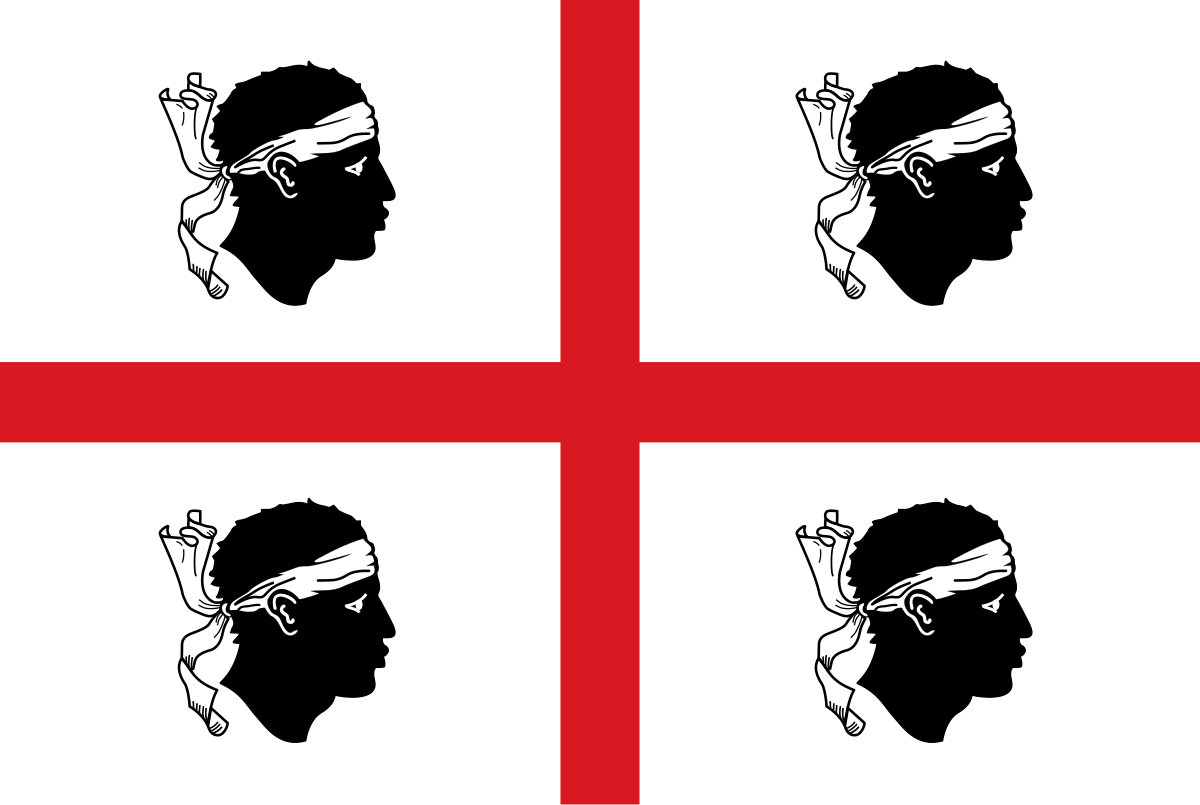
The flag of Sardinia, known as the “Flag of the Four Moors” (Flagga dei Quattro Mori), features a white background with a red cross and four black Moorish heads. The origins of this flag are often linked to the medieval history of Sardinia and its connections to the Iberian Peninsula.
In heraldry, the four Moorish heads represent the victory over the Moors during the Crusades and symbolize the island’s resistance and identity. The flag is a significant emblem for Sardinians, and it displays the historical and cultural ties to both Sardinia and the broader Mediterranean region.
Sardinia History
Sardinia has a rich and diverse history that stretches back thousands of years. The island has been inhabited since the Paleolithic era, with evidence of early human settlements. Over the centuries, Sardinia has been influenced by various cultures and civilizations, including the Nuragic civilization, which flourished from the Bronze Age onwards and is known for its distinctive stone structures called nuraghi.
During the classical period, Sardinia became part of the Phoenician and later the Carthaginian empires. In 238 BC, the island was seized by the Romans and integrated into the Roman Empire, flourishing as an important maritime center. Following the fall of Rome, Sardinia experienced a series of invasions and occupations, including the Vandals and the Byzantines.
In the Middle Ages, Sardinia was ruled by several foreign powers, including the Pisans, Aragonese, and the Spanish Crown. This period saw the establishment of the Kingdom of Sardinia, which was later united with the Kingdom of Italy in the 19th century.
Sardinia’s history is also marked by its unique cultural heritage, including traditional crafts, music, and the vibrant Sardinian language, which is still spoken by many residents today. The island’s diverse history and cultural landscape contribute to its distinct identity within Italy and the Mediterranean region.
Moors
Iberian Peninsula
The Iberian Peninsula is a southwestern European region primarily occupied by Spain and Portugal, but also includes the small territory of Andorra and the British Overseas Territory of Gibraltar. It is bordered to the north and northwest by the Bay of Biscay, to the west by the Atlantic Ocean, and to the southeast by the Mediterranean Sea.
The peninsula is characterized by a diverse geography that includes mountains, plateaus, and fertile plains. Major mountain ranges include the Pyrenees, which separate Spain from France, and the Sierra Nevada in southern Spain. The major rivers include the Tagus, Ebro, and Douro.
Historically, the Iberian Peninsula has been a melting pot of various cultures and civilizations, including the Iberians, Celts, Phoenicians, Romans, Visigoths, Moors, and later, the Christian kingdoms during the Reconquista. The Muslim occupation of the Iberian Peninsula, which lasted nearly 800 years, greatly influenced its architecture, language, and culture.
In modern times, the Iberian Peninsula has played a crucial role in European history, particularly during the Age of Exploration, when Spanish and Portuguese explorers set out to discover new lands, leading to the establishment of vast empires in the Americas, Africa, and Asia. Today, the peninsula is known for its rich cultural heritage, vibrant traditions, and languages, including Spanish, Portuguese, Catalan, and Galician.
Economically, the Iberian Peninsula is significant for its agriculture, tourism, and industry, contributing to the overall economic landscape of Europe.
 Digital Information Publishing