

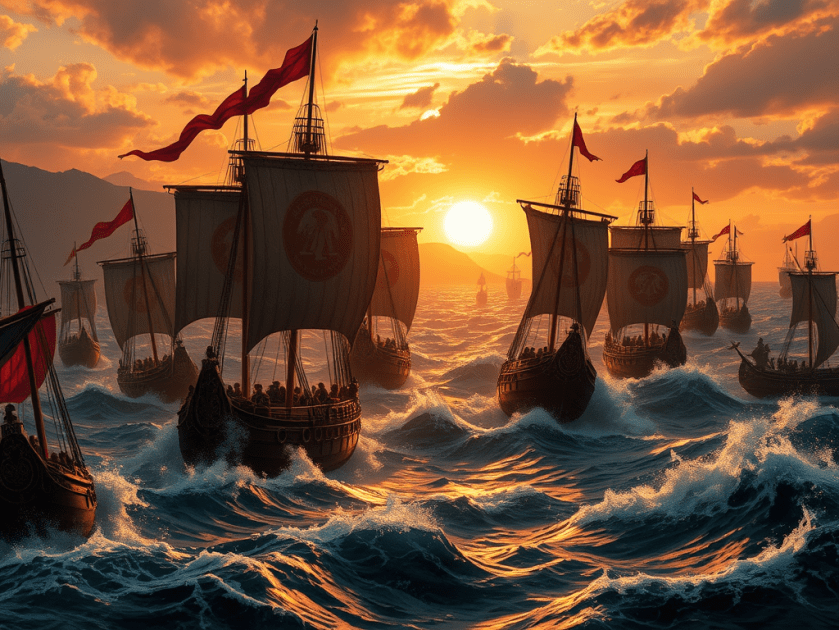
The Punic Wars: 264-146 BC
The Punic Wars were a series of three significant military conflicts fought between the ancient city-states of Carthage and Rome. Spanning from 264 BC to 146 BC, these wars were crucial in establishing Rome’s dominance in the Mediterranean world.
First Punic War (264-241 BC)
The First Punic War began over a dispute concerning Sicily, which both Rome and Carthage claimed. Over nearly 23 years of fighting, the main theaters of conflict included naval battles and land engagements. Rome eventually overcame Carthage’s naval supremacy through innovations in shipbuilding and tactics. The war concluded with Carthage’s defeat and the Treaty of Lutatius, which marked the beginning of Roman expansion beyond the Italian Peninsula as Sicily became Rome’s first province.
Second Punic War (218-201 BC)
The Second Punic War is best known for the military genius of Carthaginian general Hannibal Barca, who famously crossed the Alps to invade Italy. Hannibal scored remarkable victories against Roman forces, notably at the Battle of Cannae in 216 BC. However, despite his successes in Italy, Rome was able to recover and counterattack in North Africa under Scipio Africanus. The war ended with the decisive Battle of Zama in 202 BC, leading to Carthage’s surrender and significant territorial losses, as well as reparations that crippled its economy.
Third Punic War (149-146 BC)
The Third Punic War arose from the lingering Roman fear of a resurgent Carthage. This conflict was primarily characterized by the Roman siege of Carthage, which lasted for three years. In 146 BC, the Romans captured and utterly destroyed the city of Carthage, resulting in significant loss of life and the enslavement of survivors. Following the war, the territory of Carthage was transformed into the Roman province of Africa.
Consequences of the Punic Wars
The consequences of the Punic Wars were far-reaching. Rome emerged as a formidable naval and military power, controlling key territories in the Mediterranean. The wars also signaled the decline of Carthage as a major power. Additionally, the conflicts set the stage for future Roman expansion and contributed to the eventual establishment of the Roman Empire. The destruction of Carthage represented a crucial turning point in Mediterranean history, influencing the region’s political landscape for centuries to come.
 Digital Information Publishing