

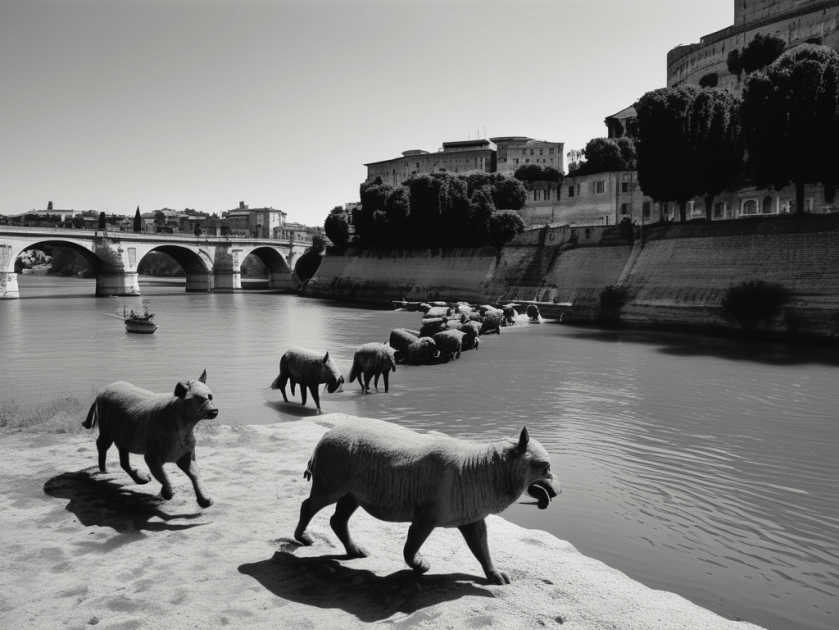
Romulus and Remus
Romulus and Remus are central figures in the myth of the founding of Rome. According to the legend, they were twin brothers who were raised by a she-wolf and later founded the city of Rome. The story goes that the twins were descendants of the god Mars and the mortal princess Rhea Silvia. As infants, they were abandoned by the Tiber River and were discovered and nursed by the she-wolf.
As adults, Romulus and Remus sought to establish a new city, but a disagreement led to conflict between them. Romulus ultimately killed Remus and went on to become the first king of Rome, which was named after him.
The tale of Romulus and Remus has been the subject of numerous artistic representations and has had a profound impact on Roman culture and identity.
Tiber River
The Tiber River is a significant river in central Italy, flowing through Rome and ultimately emptying into the Tyrrhenian Sea. It holds great historical and cultural importance as it is closely linked to the founding myth of Rome. According to the legend of Romulus and Remus, the twin brothers were abandoned and discovered near the banks of the Tiber River, where they were then nursed by a she-wolf. The river has played a vital role in the development of the city and has been an enduring symbol in Roman history and culture.
The Tiber River has also been celebrated in various works of art and literature throughout history, further solidifying its place in the collective consciousness. With its undeniable significance, the Tiber River remains an integral part of the story of Rome.
Japheth
Japheth is a significant figure in the Hebrew Bible and the Quran, known as one of the sons of Noah. In the biblical account, Japheth is listed as one of the three sons of Noah, along with Shem and Ham. According to the narrative, he became the father of various peoples, forming a part of the genealogy that is elaborated upon in subsequent biblical passages.
Japheth’s descendants are traditionally associated with the northern regions of the ancient world, and his name is linked to the concept of expansion and enlargement in Hebrew. In Islamic tradition, Japheth is referred to as “Yafith.”
The portrayal and significance of Japheth may vary across different religious and cultural contexts, but his role as a progenitor of diverse nations remains an enduring aspect of his legacy.
Northern Regions Of The Ancient World
The northern regions of the ancient world encompassed diverse territories that played significant roles in the historical, cultural, and geopolitical landscapes of antiquity. These areas were characterized by a range of civilizations, each with its own unique contributions to the development of human history.
One of the prominent northern regions was the ancient Near East, encompassing lands such as Mesopotamia, Assyria, and Babylonia. This region was heralded for its advancements in writing, governance, and urban development, laying the foundation for subsequent cultures.
Further to the west, the ancient Mediterranean world featured influential civilizations such as the Greek city-states and the Roman Empire. These societies wielded immense influence in areas ranging from philosophy and the arts to military conquests and governance.
Beyond the Mediterranean, the northern expanses included the lands of the Celtic and Germanic tribes, whose rich traditions and interactions with the Mediterranean powers shaped the cultural tapestry of Europe.
As a whole, the northern regions of the ancient world were characterized by a dynamic interplay of civilizations, each contributing to the intricate mosaic of human history.
 Digital Information Publishing