

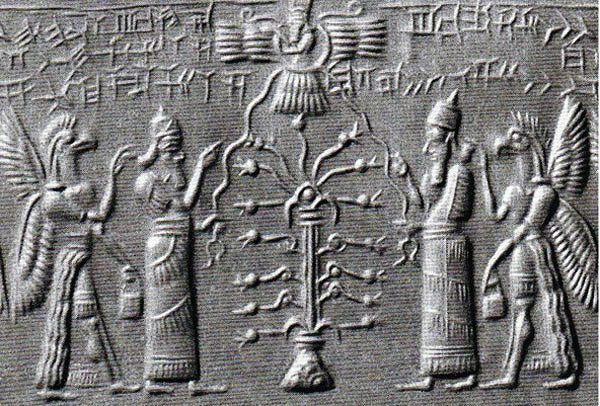
The Anunnaki are a group of deities found in ancient Mesopotamian mythology. They were worshipped by the Sumerians, Akkadians, Babylonians, and Assyrians. The name “Anunnaki” translates to “those who came from heaven to earth.” They were believed to be the gods who created humans and ruled over various aspects of life on Earth. The Anunnaki were often associated with specific natural phenomena, such as the sun, moon, planets, and seasons. They played a significant role in the religious beliefs and rituals of the ancient Mesopotamian civilizations.
Reptilians, also known as reptoids or lizard people, are beings that feature in various conspiracy theories and fringe beliefs. According to these theories, reptilians are said to be shape-shifting creatures that have infiltrated human society, often holding positions of power and influence.
The concept of reptilians can be traced back to different mythologies and folklore around the world, such as the ancient Sumerian belief in the Annunaki. In modern times, reptilians gained prominence in conspiracy theories popularized by writers like David Icke. These theories assert that reptilian beings come from another dimension or planet and have secret agendas to control humanity.
It’s important to note that the existence of reptilians is not supported by scientific evidence, and mainstream researchers and academics consider these claims to be pseudoscience or pure fiction. The theories surrounding reptilians often feed into broader conspiracy narratives and are not widely accepted in the scientific community.
The reptilian brain, also known as the reptilian complex or the reptilian brainstem, is a term used to describe the most primitive part of the human brain. It is named after the resemblance it bears to the brains of reptiles.
The reptilian brain is primarily responsible for instinctual and survival behaviors. It controls basic bodily functions such as breathing, heart rate, and digestion. It also plays a role in determining basic emotions and behaviors, including aggression, territoriality, and dominance.
This part of the brain, known scientifically as the brainstem and basal ganglia, evolved early in the evolution of vertebrates and is shared by all reptiles, birds, and mammals. It serves as the foundation upon which more advanced brain structures have developed in evolution.
While the reptilian brain still influences human behavior to some extent, it is important to note that humans also possess more sophisticated brain structures, such as the limbic system and neocortex, which are responsible for higher cognitive functions such as reasoning, language, and creativity.
Understanding the role of the reptilian brain can provide insights into certain behaviors and instincts that are deeply ingrained in human biology. However, it is essential to consider the complexity of human behavior and the influence of other brain regions when examining the reptilian brain’s impact on our lives.
 Digital Information Publishing