
Yama is a prominent figure in Hinduism, recognized as the god of death and the afterlife. In the Vedas, he is depicted as the first mortal who died and discovered the way to the celestial realm. Yama is responsible for guiding the souls of the deceased to the afterlife and overseeing the cycle of rebirth. He is often portrayed as having a dual role as a fearsome judge and a compassionate guide, reflecting the complex nature of death and the afterlife in Hindu belief. Wes Penre is a researcher known for his alternative perspectives on various spiritual and metaphysical topics.
Pitra Loka
Pitra Loka, also known as the realm of the ancestors, is a significant concept in Hinduism and is closely associated with the god Yama. In Hindu belief, it is the realm where the spirits of the deceased ancestors reside and is overseen by Yama. This realm is pivotal in the afterlife journey as it is where the deceased are believed to reunite with their ancestors and undergo further spiritual development before potential rebirth. The significance of Pitra Loka underscores the importance of ancestral reverence and the continuity of the cycle of life and death in Hindu cosmology.
14 Lokas Earthly Planes “Flat Earth Theory”
The concept of “14 Lokas” refers to the 14 realms or worlds in Hindu cosmology, each with its own unique characteristics and inhabitants. According to Hindu mythology, these Lokas exist in a hierarchical structure, with the Earthly planes, known as Bhuloka, being just one of the fourteen.
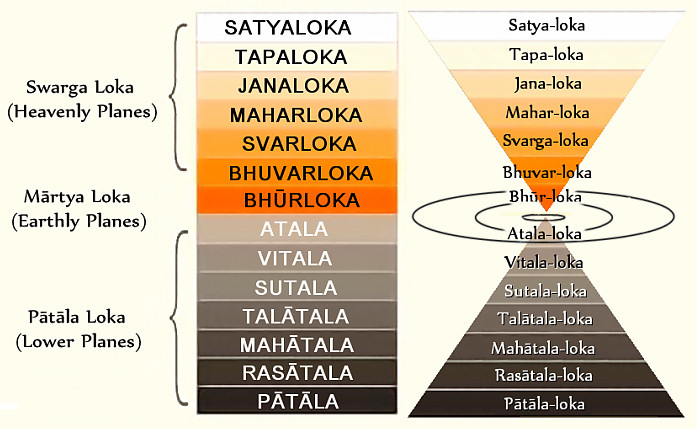
Rulers of the 14 Lokas in Hindu Cosmology
In Hindu cosmology, the 14 Lokas are presided over by various rulers or deities, each responsible for overseeing and maintaining their respective realms. These Lokas, or worlds, exist in a hierarchical structure, reflecting the diverse dimensions of existence in Hindu mythology. The following is a brief overview of the rulers associated with each of the 14 Lokas:
- Satya Loka: This highest Loka is presided over by Lord Brahma, the creator of the universe in Hindu belief.
- Tapa Loka: Ruled by Lord Jana, this Loka is associated with penance and meditation.
- Jana Loka: Lord Rishi Sanat Kumara is the ruler of this Loka, which is inhabited by great sages.
- Mahar Loka: Also known as the abode of the great sages, this Loka is ruled by the four Kumaras, the celestial sons of Lord Brahma.
- Svar Loka: Lord Indra, the king of the Devas (celestial beings), governs this realm.
- Bhuvar Loka: Another realm under the rule of Lord Indra, Bhuvar Loka is situated between Earth and Svar Loka.
- Bhur Loka (Earth): As mentioned previously, this is the earthly plane or physical realm where mortal beings reside, influenced by their actions and the cycle of life, death, and rebirth.
- Atala Loka: Ruled by the demon Bala, this Loka is said to be characterized by luxury and material enjoyment.
- Vitala Loka: Here, Lord Yama is the ruler, presiding over the realm of the deceased ancestors.
- Sutala Loka: King Mahabali governs this Loka, which is known for its opulence and prosperity.
- Talatala Loka: The demon king Maya is associated with this Loka, marked by grandeur and wealth.
- Mahatala Loka: Presided over by the demon lord Namuci, this realm is linked to the unending war between the Devas and the Danavas (demons).
- Rasatala Loka: Lord Shesha Naga, the serpent king, rules this Loka, which is inhabited by the Nagas (serpent beings).
- Patala Loka: Finally, the lowest of the 14 Lokas is governed by the demon lord Vasuki.
Devas vs Danavas
In Hindu mythology, the Devas and the Danavas are two opposing groups or classes of celestial beings that play significant roles in the cosmic order. The Devas, also known as celestial beings or gods, are associated with virtue, righteousness, and positive forces in the universe. They are usually aligned with cosmic preservation and the maintenance of order.
On the other hand, the Danavas, often referred to as demons, are depicted as the adversaries of the Devas. They are associated with malevolence, chaos, and negative forces in the universe. The interactions and conflicts between the Devas and the Danavas are often symbolic of the eternal struggle between good and evil, order and chaos, within Hindu cosmology.
This dynamic interplay between the Devas and the Danavas contributes to the narrative complexity and moral framework of Hindu mythology, reflecting the eternal struggle between opposing forces in the cosmic balance.
Each of these Lokas and their respective rulers contributes to the intricate tapestry of Hindu cosmology, reflecting the diverse manifestations and dimensions of existence within the tradition.
Bhuloka
In Hindu cosmology, Bhuloka, also known as Bhu-mandala, refers to the earthly plane or the physical realm where human beings reside. It is believed to consist of seven concentric islands separated by seven concentric oceans, with Mount Meru at the center. Bhuloka is just one of the fourteen Lokas and is considered the realm where mortal beings experience the cycle of life, death, and rebirth. According to Hindu mythology, it is the realm where human actions directly influence the course of their spiritual journey and ultimate liberation.
 Digital Information Publishing