

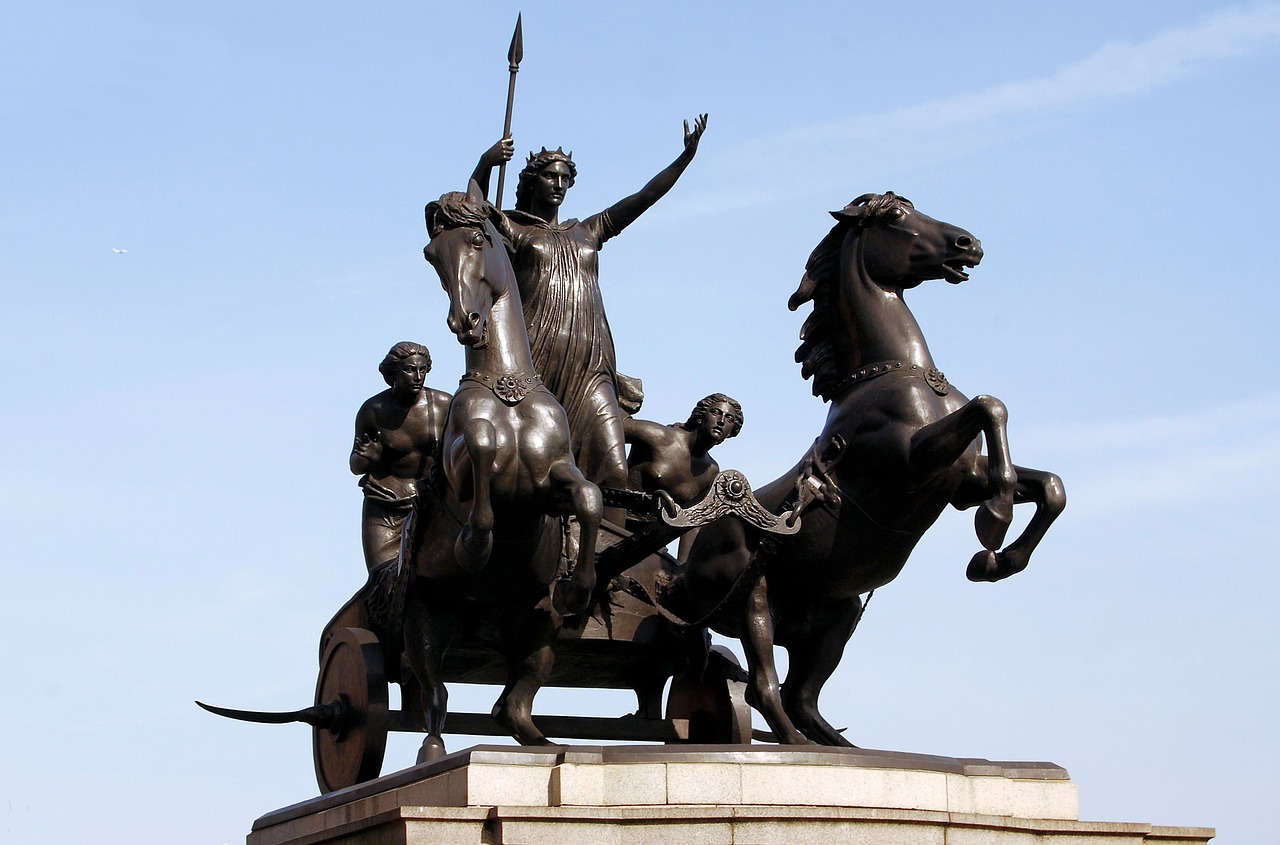
Londinium next,’ they said. ‘The army is going to do the same there as they did in Camulodunum.’ They didn’t expect the rest of the army to come marching down Watling Street from Mona in response. The Romans made for Londinium, but we were too many for the Roman army and so they left.Londinium was not important enough, evidently, for the Romans to fight for it. In spite of the pleas of the population, mainly traders and merchant vessels. Suetonius, the commander of the army, left the city to Boudicca.Our army reached Londinium, and finding little or no resistance, they razed that to the ground too, just like Camulodunum. Many of the population had left with Suetonius, but the army put those who had remained to the sword, then burned the buildings.The same fate awaited Verulamium, a little further north. The slaughter was terrible, they said. Boudicca had no interest in taking prisoners even as slaves, but killed everyone in the most brutal fashions she could think of. They say that in the slaughter, of the three towns, between seventy and eighty thousand people were killed.Boudicca and her followers made sacrifices of some of these people to the gods. Were the gods pleased? who knows. The following events don’t seem to suggest as much.While Boudicca and her allies were slaughtering and burning, Suetonius was busy. He regrouped his army and he called on his own force, the Legio XIV Gemina, and some vexillationes from the XX Valeria Victrix. Although the Legio II Augusta di not come to Suetonius’s call, nevertheless he managed to amass around ten thousand men. Then they marched to meetour army. Suetonius took a stand somewhere along Watling Street, in a small valley with a wood behind him. He was still heavily outnumberd by Boudicca’s forces, though. Our army, I was told, numbered about 230,000.Boudicca made a speech from her chariot and fired up her army. She pointed out that the gods were with them because they had already routed one legion, She did not, of course, mention that it was not the full legion.Well, a number of things were against our army that day. The terrain was narrow, being in a valley, and so we could not put any more men forward at a time than the Romans could. Then, in that valley, our chariots proved to be not very manoeverable. At first, when we attacked, the Romans threw heavy pila at us. These were a kind of javelin, and they killed thousands of our men, rushing forward to engage battle.Then they formed a wedge and forced our men back. They were highly disciplined, and our troops were not. We fought as every man for himself and all rushed forward as individuals, with no thought for co-operation with each other.
Then the men were forced back against the wagons where the women and children waited. That was another thing. The Romans did not bring their families to battle.The long and short of it is that we were defeated, and heavily. Boudicca poisoned herself rather than submit to the Romans, no one knows what happened to her daughers. Perhaps they were taken as slaves, perhaps they, too, committed suicide, or perhaps, just perhaps,they might have escaped.They say that after this battle, Nero was ready to abandon Britannia. Unfortunately, though, he didn’t. After the uprising, Suetonius started to conduct punitive operations, but Nero feared he would trigger a new uprising so replaced him. He replaced Suetonius with our current governor, Publius Petronius Turpilianus.So that is where we are today. Under the rule of Rome. They, the Romans, say it’s good. We are at peace. they’ve stopped the inter-tribal wars and brought us what they say is culture. But we had culture before. It was just not the same as the Romans.
If you enjoyed this post,
consider visiting my website to find other posts. http://aspholessaria.wordpress.com
Or you can read my book, Vengeance of a Slave, set a little after Boudicca’s revolt.http://mybook.to/vengeanceofaslave
 Digital Information Publishing